Final Thoughts – Summer 2018

(A quick note: as of this writeup, shows comprising more than one cour are getting separated out and discussed at the end of the year, so Lupin Part V, My Hero Academia, Major 2nd, and Steins;Gate 0 will not be part of this list, though I’ll still be writing Final Thoughts posts for them as I complete them.)

What a mixed bag of a season for me to finally finish on time.

We had a few triumphs, sure, but this summer was pretty solidly running at a 6/10, with some high points but a lot of average-to-low stuff dragging it down. I was really hoping for better from several of the shows on this list, but overall this was a strangely weak summer with a bunch of disappointment. As before, I’ll mention what I skipped first.

* Attack on Titan Season 3, FLCL Progressive and Overlord Season 3 because I haven’t seen either of their previous seasons.

* Hi Score Girl, Back Street Girls and Sirius the Jaeger because they were picked up by Netflix. (I’m considering doing a Netflix writeup for the whole year at a later date)

* Free! Dive to the Future because I’m waiting for the release of the prequel movie that sets it up, and Funimation taking their sweet time with it instead of pushing it out before the show aggravates me.

Worst of the Season: The Master of Ragnarok and Blesser of Einherjar (1/10)

Two very similar and similarly terrible shows emerged this season, but of the two, I ultimately have to say that Master of Ragnarok was the more heinous. The writing in this show was, over time, consistently insulting to the point of near-parody. Not only have we already seen the concept of guy-with-smartphone-in-another-world before, but this one added in even more stupid harem nonsense than before and contrived a situation where everyone in his harem referred to him as either their father or their big brother, all while constantly wanting to fuck him. It also just looked flat-out awful and half-finished.

How NOT to Summon a Demon Lord (2/10)

Yeah, I ultimately had to bump Demon Lord to a 2 just in comparison to Master of Ragnarok, because even though I still loathe the idea of the harem being literally enslaved, from what I understand (I still haven’t even watched the entire first episode because what would I get out of it?) the world-building in the show has at least been passable and the plot isn’t total garbage. That being said, I won’t say much more on this one because I didn’t experience the whole thing.

Lord of Vermilion: The Crimson King (2/10)

The first entry on the list I straight-up forgot existed. It’s edgy garbage that doesn’t have the substance or production to make even the first episode worth finishing, and I do remember wondering if my VRV app was having trouble buffering it. Nope, the show is just a slideshow.

Music Girls (3/10)

Oh boy, did this one not even stand a shadow of a chance airing in the same season as Revue Starlight. Music Girls just struck me as having almost no effort put into it at all, aside from developing one of the ugliest art designs I’ve ever seen in anime. The first episode was boring as hell and was so generic that it makes me wonder how the director behind The Galaxy Railways ever ended up here. Did he wander in, confused, and they just drafted him into a garbage fire?

ISLAND (3/10)

If ISLAND had been spun as a satire of KyoAni Key adaptations like Clannad or Air, I would have probably thought it was hilarious, but instead this twelve-car pileup of cliches was meant to be taken entirely seriously. A man with amnesia washes up on a mysterious island in a town that dislikes outsiders, is really cool about the whole thing, and the girl he’s trying to meet might be a vampire because she never goes outside and is only awake at night? With no subtlety or nuance at all, and a huge age difference between Main Guy and the girls? It would have been better if they had been joking.

Dropkick On My Devil! (3/10)

Dropkick was a strange beast that I didn’t finish the premiere of because I could tell right away that it would be a low-effort, derivative comedy that should probably have been a short rather than a full-length TV series. It’s basically an even less original Gabriel Dropout! and I was not about that.

The Thousand Musketeers (4/10)

The Thousand Musketeers commits the sin of just not being interesting enough. We’ve seen what can happen when mobage adaptations are done well (we get Love Live! or Katsugeki/Touken Ranbu) so I don’t get why there are still ones that are just poorly animated snoozes. The Thousand Musketeers isn’t awful, but it has no excuses, and I do not understand for the life of me why HIDIVE tried so hard to push it instead of throwing all its weight behind Revue Starlight.

Holmes of Kyoto (4/10)

The first show on the list that I didn’t drop after the first episode, Holmes at least started with an interesting and chill premise but ultimately tried too hard to push a plot that didn’t make sense and didn’t have enough narrative stakes to get the viewer invested.

Seven Senses of the Re’Union (4/10)

The biggest disappointment of the season, Seven Senses got a running score of 8/10 on my midseason writeup before everything went very, very wrong. It’s been a full week since I’ve watched it and the ending still infuriates me just to think about it, but ultimately the story jumped the shark in episode 8 with a plot development that could have reasonably been recovered from had the finale decided to resolve literally a single thing instead of just pretending that killing a low-tier villain solved all of the cast’s problems.

Phantom in the Twilight (5/10)

Phantom is another show that just couldn’t keep me interested in it. Three episodes in, the production had not improved and the characters had run out of time to become interesting. Like I said in my writeup, it seemed to be aiming for a 6, and it should not have been rewarded for it. I still think this idea could have worked if given an Atlus makeover.

Angels of Death (4/10)

I had at least a little bit of hope for Angels, but ultimately I could just no longer stand main character Rachel or the inane story being told, clearly in an attempt to cash in on the unadaptability of Zero Escape. I still like Isaac as a character, but he couldn’t save a show that just faded into boring mush seven episodes in.

Unrated: Asobi Asobase -workshop of fun-

Like I said, I could see why this one got a lot of positive press, but it was just not for me.

Unrated: Yuuna and the Haunted Hot Springs

Another show that was just not going to be my cup of tea. If the TNA community wants it, that’s fine, but I wasn’t gonna try to pretend this was anything better or worse than it was.

Unrated: Planet With

I’m still embarrassed by this one, and my inability to see what everyone else seems to be seeing in it. I imagine I’ll revisit and reevaluate it later if only to resolve what feels like a black mark on my critical viewing.

On-Hold: Cells at Work!

Cells at Work! hasn’t done much other than not be what I was hoping for out of it. I typically cannot get into episodic shows because I don’t see what’s supposed to be hooking me, and with no overarching plot to speak of, it was doomed on part from the beginning. The first episode is still terrific, but I don’t want to watch it 13 times, you know?

On-Hole: Chio’s School Road

Of the comedies this season, Chio was the one I just never managed to make up my mind on. From what I’ve heard, it’s wildly inconsistent with its humor and that’s kind of scared me away.

AND NOW, the stuff I actually liked!

Harukana Receive (7/10)
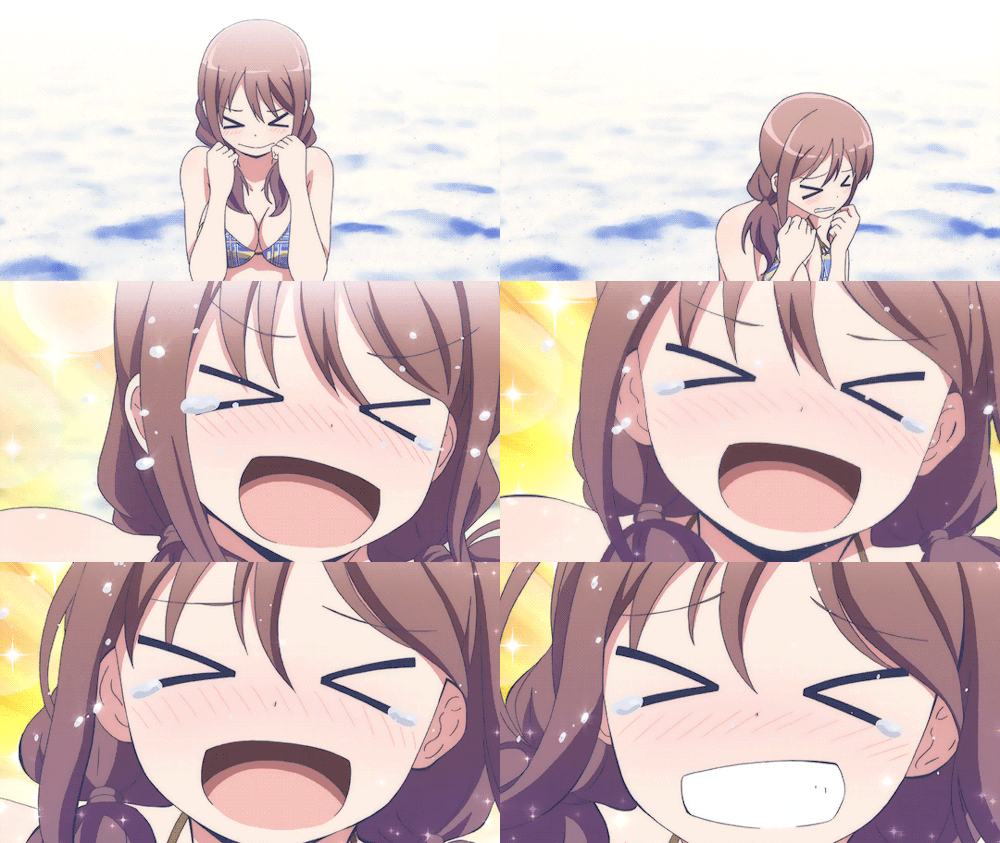
Sometimes, a simple premise can work well with good execution. Harukana Receive didn’t try extra hard, but it didn’t have to, running at a consistent pace throughout to deliver a good story that isn’t made worse just by its lack of originality. If you miss Haikyu!, you’re better off with this than…

HANEBADO! (7/10)

A frustrating viewing experience where the matches are beautiful and most of the cast make no sense. The melodrama here is pumped up a little too high for the script to keep up with, and it results in a show where one of the main characters becomes more of a villain than the antagonists, despite the fact that the show still seems to be trying to get the audience to root for her. So, come for the visuals, but don’t expect the story to match in quality.

Grand Blue Dreaming (7/10)
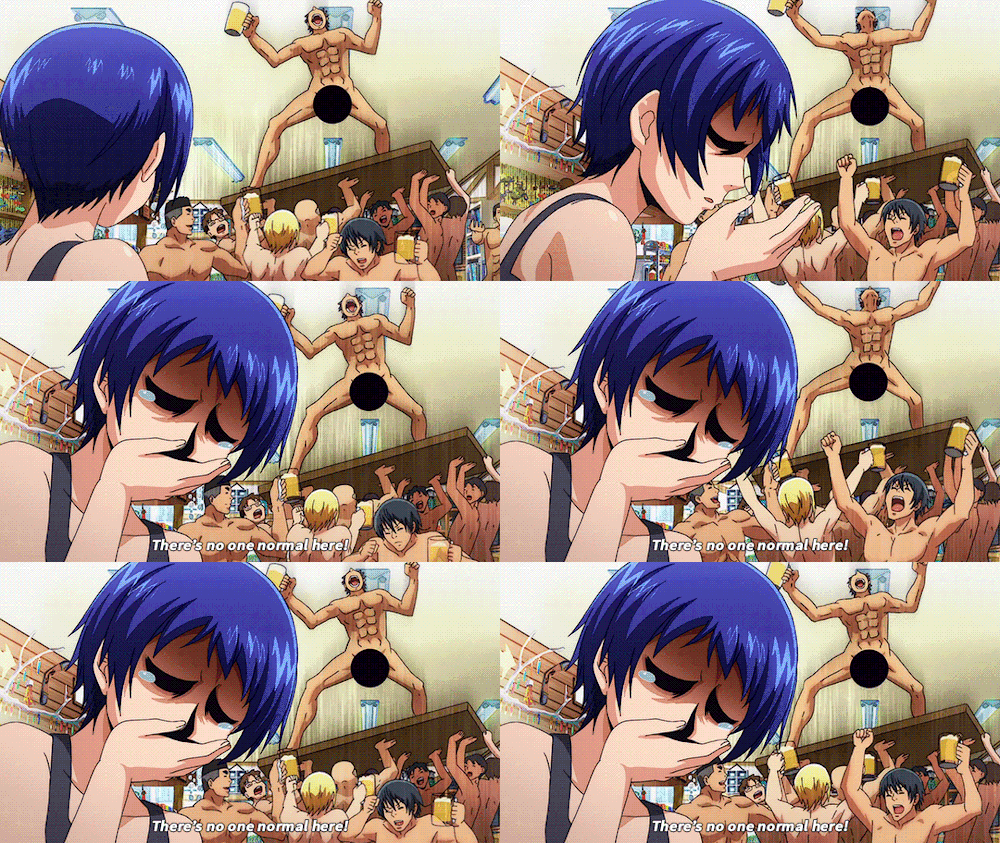
A strange comedy that mixes typical situations with a large dose of alcohol and nudity, and comes away looking very unique and unrepentant in its stupidity. The best dumb shows are intentionally dumb, and any show with this many naked guys is absolutely in on the joke.

Angolmois: Record of Mongol Invasion (8/10)

It’s been a good while since I’ve seen a decent bloodfest, and this one follows in the tradition of samurai cinema by going over the top while telling a story of redemption in the face of hopeless odds. While the ending wasn’t perfect, the action is visceral and satisfying, and our hero Jinzaburou manages to be a credible badass.

Best of the Season: Tie

Revue Starlight (9/10)

Revue Starlight hit a few early bumps in the road that thankfully managed to be left in the dust in the second half, delivering a coded love story about two girls and what they will do to fulfill a childhood promise to each other. Distinguishing itself massively from others in the idol genre, Revue Starlight traded in musical numbers for dramatic, excellently-staged fight scenes where interpersonal drama can be resolved through creatively theatric swordfights and magical girl-style transformations. An absolutely worthy substitute to the unlicensed fourth season of Symphogear.

Happy Sugar Life (9/10)

A near-masterfully plotted thriller that expertly balances oversaccharine fluff with underlying violent tension, Happy Sugar Life is a story I’ve never seen before and an examination of psychopathy and the logical extreme of the very concept of moe. It stumbles only slightly in its ending and the over-the-top characters, but ultimately comes out way ahead of much of its seasonal competition.

Final Thoughts – HANEBADO!

A very attractive mess.

There’s no mincing words here – HANEBADO! looks gorgeous in motion. It is perhaps the best-looking show of the season outside of Attack on Titan or Revue Starlight, and while it can look a little wonky in the still shots, the matches are directed impeccably, with very ambitious camera placements forcing the quality animation to keep up, and it absolutely does.

But the story is all over the place, with characters going in very strange directions in the second half, and our protagonist going from a childish prodigy to a sociopath. The in-universe explanation makes sense – she gets it from her mom, who abandoned her for years in order to focus on the sport – but it makes it very, very difficult to root for her and pretty much causes the hero position to shift back to Aragaki by the final match, with Hanesaki’s team trying to snap her out of it and her cruelly brushing them off.

So character-wise, we have an unfortunate mixed bag that makes for a really strange show. The production team certainly tried hard and succeeded greatly, but the changes from the manga caused the story to become questionable, almost nonsensical, with a very inconclusive ending showcasing little growth on the part of the characters.

So, yeah, I’ll give it a 7/10 if only for the visual spectacle, but having few decent characters, I wouldn’t recommend it as much as Harukana Receive or Major 2nd.

Final Thoughts – Happy Sugar Life

See, sometimes I can have nice things.

Happy Sugar Life was, from the beginning, a complicated show. As of this final episode, we have come back around to the first scene – a mutual suicide by way of jumping from a burning building. And, while I’m not sure I’ve fully processed the ending, I also can’t think of a better one, because if Satou had survived then the show’s message would have failed dramatically.

Everyone gets punished for their sins.

The characters in this show are nearly all insane, and nobody escapes entirely unscathed, whether it’s Satou for her selfishness costing an innocent life, Mitsuboshi for his deceitfulness, or Asahi for his desire to take his sister back to her abusive home life purely for his own desire. I appreciate that their sins weren’t all weighed equally in the end, and that their individual victimhood led them to these dark places.

This show kept me right on the line the entire way through, by subverting my expectations as an anime viewer. Every time the viewer comes close to sympathizing with our irredeemable heroine, we get harshly reminded that she is a psychopath who will burn it all down in order to keep her fantasy alive.

The one thing harshing my buzz about this story is Shio herself, and her ultimate reduction into being more of an idea than a character. She is something that our trio of nutjobs are chasing for different reasons – Satou to fulfill her need for sexless love, Mitsuboshi for nearly the opposite reason (very nearly admitting multiple times that he wants her intimately), and Asahi because he believes that a “complete” family can make him happy again. I would have liked to see at least a more hopeful ending for Shio herself, though.

But honestly, Happy Sugar Life has been a crazy, nerve-wracking ride since the very first scene, repeated here: wedding music played during a death scene. Satou’s castle crumbles, and, as often happens, its ruler goes down with it instead of facing reality. I’ve never seen anything like Happy Sugar Life, and I’m so glad that we got a great ending for it.

9/10.

Manga Review – Shortcake Cake, Volume 1

A formulaic but charming romantic comedy with a few early shake-ups.

The story begins with our heroine Ten moving into a boarding house near her new high school, in order to save time on the two-hour commute, where she meets six friends, two of whom are, of course, very eligible boys. The setup is not unlike Dreamin’ Sun, but Shortcake Cake carries a lot more energy and speedy pacing – the love triangle is set up by the end of this first book and the boys in question are already aware of it, and one last twist really gets the story going, provided the next chapter actually sticks to it.

The one element I’m not totally on-board with is the art, which isn’t bad but can look a little bit lazy at times. The author leans a little too much on super-deformed faces and far-away character shots without fine details, and I noticed a few instances where the background work was half-baked enough that the characters wound up halo’ed because otherwise their heads would have blended into the scene behind them rather than just sticking out on their own.

Overall, though, this first volume was enjoyable, even if it wasn’t particularly ambitious. We see repeated plots like this because the elements can still work, they just won’t be very challenging.

Score so far: 7/10

Final Thoughts – Revue Starlight

It wins “Most Improved” by a country mile.

I was pretty unsteady on this show when I tried to cover it weekly, but by the halfway point it had managed to recover the intrigue of its first episode and ramp up the story in a very satisfying way. I’m really impressed by how much better this managed to get, all leading up to an incredibly satisfying ending which takes the show in a different direction than I had expected, in the best way.

It also remained gorgeous throughout, despite a troubled production, and several scenes in the last few episodes were nothing short of breathtakingly animated. Even the CG work doesn’t disappoint, running at the correct framerate and managing to still look lifelike even though it’s noticeable. I want to especially declare the fight scenes here to be some of the best of the year. Even though the victor is often precluded, the bouts themselves are often mesmerizing, which is great considering they replace the more traditional musical numbers. Revue Starlight absolutely manages to make its drama work.

Studio Kinema Citrus made a name for itself last year, and while Starlight certainly isn’t as popular as Made in Abyss, it shows that that project was not a fluke. This is a production team that knows what it’s doing, and I cannot wait to see what we get out of them next.

9/10!

Final Thoughts – Angolmois: Record of Mongol Invasion

A terrifically bloody throwback.

If you know much about Asian history (or can extrapolate from the story of Mulan), you should be able to tell how this story is going to end as soon as it begins. This is not a battle our “heroes” were ever going to win, and in the end, what we get is more akin to a classic samurai redemption story for our protagonist Jinzaburou. Exiled from Japan for his past crimes, he and his fellow prisoners wash up on the shore of Tsushima and get drafted into the battle to defend the island from the coming Mongol threat.

Like many samurai stories, this one is bloody as hell, with the body count soaring as the plot goes on, and we learn more about why Jinzaburou was exiled, who he used to be, and what he’s really fighting for in defending a land that rejects him. The fight scenes in this show, particularly when the action is one-on-one (the final fight being a particular highlight) are beautifully choreographed, tying Jinzaburou’s canine aesthetic together with an animalistic sword style and genuinely cementing him as a man not to be fucked with.

What I would have liked to see from this series, however, is a slicker production (I would have loved to see this as made by ufotable) and the ever-present filter on the screen toned down just a tad, as it became distracting in more than a few places and distorted a few of the backgrounds. I also wish that the princess of the island were given a little more characterization to justify her role as the deuteragonist, because I was disappointed to see her become a tsundere when in front of our hero.

But, all-in-all, Angolmois is certainly a stand-out in what has, overall, been a pretty disappointing summer in comparison to the ridiculously packed spring.

8/10.

Final Thoughts – Seven Senses of the Re’Union

This one frustrated me to no end, because it was one of the surprise highlights of the season in its first half, and then…

The storytelling essentially jumped overboard.

The big twist was exactly what I said it would be (that the game was obviously a front) but not only does very little ultimately come of it, it isn’t even something that comes up organically. Episode 7 gets the ball rolling in the department of major contrivances, but the beginning of episode 8 takes the cake. With no explanation for how it happened at all, we suddenly get thrust into a parallel timeline for ten minutes so Haruto has somewhere quiet so that he can have the major plot infodumped to him by a character that could absolutely have told him all of this information sooner.

And what follows isn’t an unsalvageable mess, but the sheer number of plot contrivances take this out of the realm of an eight or nine, bringing it down to something I would merely consider “watchable”.

Which is a shame, because I enjoyed a lot of the themes present in this narrative. The main cast met as kids and then went six years without speaking to each other, and they’ve all got a bit of arrested development to go with that, whether it’s feelings that were never realized, a desperate grab for as much power as possible, or a desire to take your tragic past and murder the hell out of it to avoid any self-examination. I liked the idea that the game in the title isn’t a standard RPG, but rather a playground for psychic powers (which is why the rules and limitations are so unclear – there aren’t any), making it more akin to a fantasy world that just happens to have a game on top of it.

But with the collapse of the narrative and the fact that it literally never answers the biggest mysteries of the show and never will… Yeah, I’m sorry. Skip it.

4/10.

Final? Thoughts – Planet With

I’m gonna be real, I feel like I’ve failed here.

And not in the sense that a show I was championing ended up making me never want to look at it again (yeah, I’m still not pleased about what happened to KADO) but in almost the reverse. I just do not understand the utterly rapturous praise heaped onto Planet With. I would say it was good, but hardly the best of the year or even the best of the season (though this season in general has been running pretty slim).

This show has never been able to capture me again the way its premiere did, and I’m just not sure why. It’s one of the most interesting, original productions I’ve ever seen with a writer I know is reliable, and yet I was just never able to fully invest in it. Was I just not in a good mood while watching? Was I not paying close enough attention? It’s totally beyond me, and I’m gonna take full responsibility for that and leave it entirely unscored even though I finished it. Maybe at some point I’ll be able to revisit it and see it through someone else’s eyes, but for now, I’m gonna chalk it up to a loss on my part.

Final Thoughts – Harukana Receive

Good execution is still everything.

A single-cour beach volleyball show was never going to be a genre classic (and I’d heavily argue that you need at least two cours to tell a decent sports story if you aren’t going to pace it like Umamusume) but Harukana Recieve nails the sweet spot of a cute-girls show with an actual plot, even if the bones of it are certainly nothing new.

But while I’ve absolutely criticized shows for their lack of ambition before, I want to be clear that execution is still the most important element, because it tends to be far more noticeable. A competently-told story with just a few decent ideas (like Kiznaiver) will, in my opinion, always win over stories with lofty ideas but no plan for seeing them to a satisfying conclusion (like Darling in the FRANXX).

So, as for Harukana Receive, it managed to be a story with relatable characters and a properly-paced, well-told story. That may seem like I’m damning it with faint praise, but it wasn’t going for anything more than that, and it met pretty much exactly the expectations I had going into it. I have no reasonable complaints aside from the overuse of the sand effect in post-processing and the fact that I really don’t like the color composition on the main duo’s bathing suits.

It even managed to deliver a genuinely good final episode that ended on a satisfying note while also setting up for a potential continuation, something that  a lot of projects like this avert in favor of ending in the middle of the story in order to make a last-ditch boost in manga sales. (I’m still very bitter about the ending of Baby Steps, okay?) While it didn’t go for any heartstring-pulling gut shots, I’m pleased with how this story ended.

Final Score: 7/10.

Manga Review – That Blue Sky Feeling, Volume 1

A much more heartfelt and earnest romance.

And by the end of this first volume, we haven’t quite gotten there yet, but it certainly seems to be heading in that direction. That Blue Sky Feeling is probably one of the most deliberately slow-burning starts I’ve seen in queer romance manga, and in this case it’s more than welcome, because I’m finding a similar fondness for this as I had for Tsukigakirei last summer – feelings like this are complicated for young people, particularly if you’re dealing with LGBT people for the first time in your life, and even more so if you live in a country that still faces as many issues in that department as Japan, where the idea of “don’t ask, don’t tell” is certainly well in effect.

What we essentially have here is a realistic coming-of-age story about a boy – Noshiro – who has never really thought about romance or sex, wanting to befriend another boy – Sanada – who he knows is gay, simply because he’s alone all the time. What unfolds from there is a really well-paced story where a lot happens in just one volume, but the progression of the plot feels very natural, and our hero does not seem to have come close to realizing his own feelings yet, even though he can describe the way he feels about his new friend. The real highlight of the story is Sanada’s ex-boyfriend Hide, who takes on a mature mentor role to the adolescent struggles of Noshiro and Sanada, and winds up intentionally meddling in their friendship simply because he knows Sanada well enough to see that he’s unwilling to let his guard down, which is why he’s so frequently alone.

I honestly don’t have much more to describe the story other than telling you to go read it, but the artwork is incredibly soft and clean-looking. I very much like Noshiro’s character design, as his young-bara body type clues you in quickly that this isn’t a story meant for women to fetishize, like Hanger is, but instead is meant to be something more rational and thought-out. (Generally in BL stories written for a female audience, the boys in question will very rarely get to be more muscular-looking than the cast of Free!, since women often don’t get as much of a physical reaction from looks as they do from personality, so the fact that boys of Noshiro’s body type are implied to be Sanada’s turn-on is also pretty telling and I love this detail.)

Basically I can’t recommend it enough and it was one of the fastest manga purchases I’ve ever decided on. 9/10.