Final Thoughts – 2018 Long Shows

It’s finally here! I’m so close to being done with 2018 (…mostly. We’ll get to it) that I can taste it, but in the meantime, this list is gonna be weird, because there will be things that were already on other lists since I revised my rules of what should be classified how. This post is specifically for any show that ended in 2018 and lasted longer than 13-ish episodes (including shows that aired a second season during the same year or within six months of finishing the previous one), which means that there’s about as much on it as a usual season of shows, but they all had more time to impress – or disappoint me. I’m doing a better job in recent seasons of getting to everything, but last year there were unfortunately things that I missed (I was burned out in the winter) and just have to leave aside for now because I can’t wait any longer for these lists.


Anyway! As usual, let’s start with what I skipped!

* The Seven Deadly Sins: Revival of the Commandments, The Disastrous Life of Saiki Kusuo S2, Cardcaptor Sakura Clear Card, Garo: Vanishing Line, and Mr Tonegawa: Middle Management Blues because I haven’t seen their previous seasons or parent works. (Yes, even Cardcaptor Sakura. Y’all can shoot me later.)

* Hakyuu Hoshin Engi, Beatless, and Basilisk: The Ouka Ninja Scrolls because by the time I was rounding things up, I hadn’t heard a single positive thing about any of them.

Next comes what I dropped –

WORST OF THE YEAR: Steins;Gate 0 (4/10)

What a fucking mess this show was. Aside from a very noticeable downgrade in production talent from its predecessor, the plot meanders and flirts with maybe actually happening this time before just dropping out again, over and over, to the point where I was perfectly willing to drop it two episodes from the finish line because it was such an insult to fans of the original. (Also, continued disgusting mistreatment of the transgender character.)

Gundam Build Divers (4/10)

Taking the Build series from being a well-written kids show to an averagely-written kids show that hides itself in decent mech designs.

Katana Maidens (4/10)

I remember so little about this show, and granted that I did drop it after one episode almost nine months ago, but what I did remember was that it gave me strong KanColle vibes with laughably inconsistent animation and flat characters. Meh.

Darling in the FRANXX (5/10)

This should probably be lower on the list, but I got out of Darling while the getting was good, sixteen episodes in. I understand that future episodes of the show cemented it as crappy right-wing nonsense in addition to pushing worldbuilding out of its fortieth-story window, but the moment it lost me was much sooner, when the crazy yandere female lead was reduced, almost instantly, to Good Anime Waifu as a reward to the protagonist for going against his friends with his selfish motives.

Persona 5 the Animation (5/10)

In addition to not actually finishing in 2018, Persona 5 just did not give me a single reason to watch it when I’d already finished the source game, with middling-to-bad visuals (thanks to the switch from Production I.G. to A-1 Pictures, and not even the team that created the much better-looking Day Breakers OVA before the game was released in the U.S.) and phoned-in music, which is especially unacceptable in a Persona adaptation. Also, we all absolutely called that the studio couldn’t tell the story of the entire game in just 26 episodes.

Record of Grancrest War (6/10)

There’s people that like this one a lot, but I didn’t see much that interested me in the first two episodes. I’ve heard better things about the manga.

Golden Kamuy (6/10)

I had problems with the first half of Golden Kamuy that the second half simply didn’t fix, and it became difficult for me to keep watching – the show still interrupted almost every fight scene with a dick joke, but still wanted to maintain a serious and occasionally frightening tone – and those things simply don’t go together. It needed to either spend more time being funny, or keep its lowest-common-denominator humor out of the fights.

Next, I have two shows that are (potentially permanently) On Hold, simply because it’s time for me to move on and I don’t have the time or energy to marathon them when the Winter shows are starting to wrap up:

Kakuriyo: Bed & Breakfast for Spirits, because even though I initially dropped it, I’ve heard a lot of good things since and I want to eventually give it another shot.

Yowamushi Pedal Glory Line, because despite the fact that I still enjoyed the previous season, this one started right in the middle of my burnout and I only heard bad things about it. I’ll get to it eventually, but it’s a shame that this series has been on a clear trend downwards since its revival.

And finally, the stuff I finished!

The Ancient Magus’ Bride (6/10)

image

Keep in mind that this is here entirely on the merits of its aesthetic and its side characters – in the end, Ancient Magus’ Bride is a Beauty and the Beast story where the beast gets what he wants without learning to be less of a dick or even apologizing for his clearly wrong actions.

Major 2nd (7/10)

image

Always pleased to have even just Good sports shows around, and this one is a very effective reboot of a classic series that’s never made its way stateside (man, the underperformance of Big Windup! really did a lot of damage to this genre in the West). With good character development and a decent second-generation premise, Major 2nd has the potential to be the beginning of a solid baseball story, assuming that it gets a needed followup.

IDOLiSH7 (7/10)

image

I dropped IDOLiSH7 when it first aired, and though I wound up enjoying it after I was very strongly urged to revisit it, the problems it started with never quite left it behind – that is, it has an okay cast of characters but doesn’t present even passable performance sequences, and if you’re going to include big song-and-dance numbers, they have to be good, or you may as well just be UtaPri.

ClassicaLoid Season 2 (8/10)

image

In 2017, I gave the first season of ClassicaLoid a near-perfect 9/10, and while this season gives us a satisfying conclusion to the story, it does things both a little better than the first, and also not quite as great. It’s story is much more well-integrated over the runtime so it doesn’t happen all at once in a few chunks, and the jokes that work are still absolute genius, but there’s simply too much that doesn’t quite land correctly, and a little too much immature humor, for it to reach the same lofty Hall of Fame heights as the first season. Still, one of the most underrated shows I’ve ever seen.

My Hero Academia Season 3 (8/10)

image

God, Izuku in that onesie is too damn cute.

My problems with Hero Academia are frustratingly persistent – the show is at its best when the students are competing with other students, because outside of last season’s Stain (a villain whose motivation is specifically related to the world of MHA), the villains are just not at all compelling and they all seem a little too generic for their own good. I just want Horikoshi to be a little bit less predictable of an author and do a little less reading of the Standard Shounen Playbook. Luckily, when it works, it works magnificently.

March Comes in Like a Lion S2 (8/10)

image

March remains director/auteur Akiyuki Shinbo’s most accessible work, and one of his masterpieces, as a well-paced and marvelously moody story of a depressed shogi prodigy learning to be a normal teenager before his youth completely passes him by, and the fantastic characters that surround him with their own complex problems and motivations. I just really, really hope it gets a third season eventually, because this one did not leave off on a satisfying conclusion.

Speaking of which…

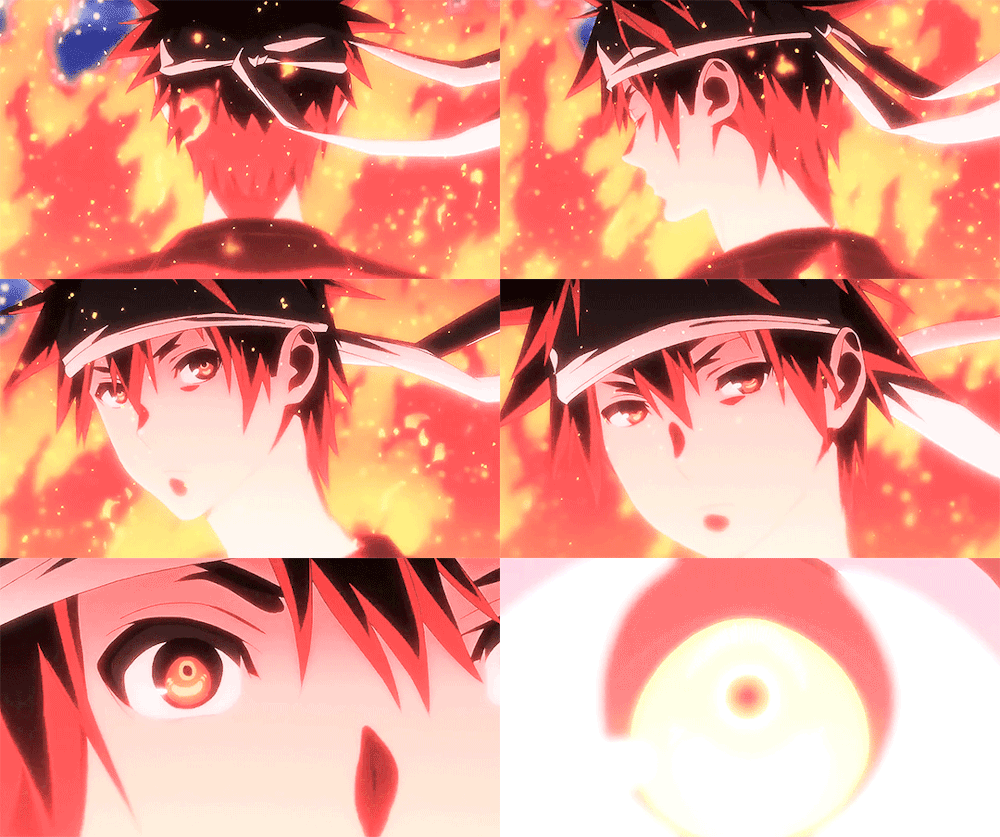
Food Wars! Shokugeki no Soma S3 (9/10)
image

It’s almost a shame that My Hero Academia became hugely popular purely based on its accessibility to American audiences, because Food Wars pretty squarely deserves to be the reigning Shonen Jump king – each season has only improved on the previous one, and this one was based entirely on a continuing arc that could only have happened in the universe of this show, Fighting Food Fascism. That being said, it also leaves off right in the middle of the arc (because it had almost caught up to the manga), meaning that we have to hope that it can remain relevant long enough for there to be enough source material for another season. I’ll be crossing my fingers until they snap.

Banana Fish (9/10)

image

Yes, this has risen a point since my review, but Banana Fish still deserves to be thought of as both a complete masterwork of crime fiction, being fantastically paced and expertly plotted in the use of its many, many twists, and a work that disappointed the side of me that hoped that, in adapting it into the modern day, MAPPA could have managed to get the author to let them depict what is clearly a queer relationship with the authenticity and legitimacy that it deserved. It’s still amazing, though, and Amazon should be pushing it with their most lavishly-made originals. At least it was the last noitaminA show they’ll get to totally bury.

And, finally, the one you all saw coming.

BEST OF THE YEAR: Lupin the 3rd Part V (10/10)

image

Lupin is, quite simply, one of the pinnacles of the medium. A simple idea that can (and did) go in thousands of different directions, handled by highly creative writers and an animation staff that has been knocking it out of the park for years, despite the fact that it is criminally (heh) unrecognized in the West. To put it simply, there’s a very, very good reason that it’s been around since the 70′s.

Okay! All I have left to do is finish Dragon Pilot (waiting on a friend) and we can get the last two lists out of the way! We’re almost done…

Final Thoughts – Banana Fish

Strap in, because this one gets complicated. Also, spoiler alert for both this and for 91 Days, because I can’t just talk about one thing, I have to swerve way out of my lane. If you don’t want to be spoiled or read a lot of rambling, I’m giving it a recommendation.

Let me start by throwing in some context. Summer 2016 saw the release of an original show by Studio Shuka (best known for the sequel seasons of Durarara!!) called 91 Days, a mob story with very deep homoerotic subtext about a boy taking revenge for the murder of his family by a crime family by infiltrating said family and becoming a close confidant to their leader, who also happens to be the insanely attractive Nero. His hotness isn’t especially relevant to my criticism, but like…

Woof.

Anyway, mob stories as a rule do not have happy endings – they usually involve villainous protagonists that have to do very bad things in order to accomplish their goals, which are also often not very noble in intention. If they happen to accomplish something good, it’s a side effect. In the end, Nero becomes very aware that his new friend has been systematically destroying his family since the moment they met, and after a lot of bloody violence, the show ends with the two of them walking alone down a beach on an overcast day. They talk about their experience, and both of them know that despite genuinely growing to like one another, it’s far, far too late for this to end well. Nero pulls out his gun, and the screen cuts to black a moment before he pulls the trigger.

It’s fucking powerful, and the entire time I watched Banana Fish, I was thinking about that ending. While Banana Fish is a very different show, if you really boil it down, it’s also a mob story about taking revenge for the loss of your family, and the things you have to do in order to achieve such a selfish goal as vengeance.

Banana Fish ends up swinging a lot wider than 91 Days, ultimately, because it brings in a lot of even more adult concepts and handles them with varying results. Rape, for instance, is mentioned a lot as something that happened in the backstory of several characters (all of whom are male, though they weren’t always the actual victims), and it’s neither handled carefully nor is it glamorized. The main character Ash actually seems to have developed a complete lack of caring about his own sexual well-being from having been involved in a lot of child pornography, and many times over the course of the story he uses his body to seduce men he needs things from because his good looks and experience are enough to make basically the entire cast want him.

But the only one he wants is the Japanese college student who suddenly got caught up in his plans, and becomes magnetized to in a way he’s completely unable to handle.

Banana Fish is the single most queer-coded show I’ve ever seen that never has the subtext rise to become pure text. The author herself has stated that in all the time Eiji and Ash spent together, they felt as lovers, but never consummated that feeling. They do embrace intimately whenever they see each other after a period of absence, but even when they share a room, they have separate beds divided by a nightstand. It’s almost strange how sudden the stop on this relationship is, like after displaying a lot of male affection and even kissing at one point (as part of a ruse), the two of them suddenly no-homoed.

I think this is probably a result of the time period the story was originally written in – like I said in my premiere review, Banana Fish as a manga was published from the mid-eighties to the mid-nineties, in a time where the U.S. was facing the AIDS crisis (so media endorsing gay relationships between men were generally not widely accepted due to the massive stigma) and Japan was…well, Japan has pretty much been “Don’t Ask, Don’t Tell” for a very long time. So writing a story that goes right up to the line for readers that seek such things out (who were certainly there, BL as a genre is now a staple in Japan, particularly among women, whom Banana Fish was targeting since it was in a shoujo magazine) but doesn’t step over it was probably ideal for the time period.

However, I really question whether the author in question (Akimi Yoshida, just to get her name in here) was opposed to changing this position, or if director Hiroko Utsumi ever considered asking her for her input, because the story has been updated to take place in the present day, when being gay in America is not a particularly big deal, especially in New York City. I’m really afraid that it’s going to be a while before we get explicitly queer shows in Japan that don’t involve the tired aggressive, rapey seme archetype like DAKAICHI or even Bloom Into You, because this would have been a pretty good chance to try that out, given that MAPPA already made a show two years ago that also toed the line without ever actually showing Yuri and Victor being together on camera (and no, even the kiss doesn’t count, they deliberately cut away from it).

We also have to deal with the fact that these stories don’t have happy endings.

After the conflict is over, and after resolving to never see Eiji again for his safety, Ash is given a letter from him that contains a plane ticket and a heartfelt plea to understand that Eiji was never afraid of his partner despite all of the violence he had been involved in, Ash begins to run to the airport, towards his happy ending…and is murdered, because cosmically that’s what he had earned. While I fully approve of this as an ending, it is still pretty firmly an example of Burying Your Gays, and warrants a lot of scrutiny because of that.

Basically, I’m not sure how I feel about it and I don’t know that I ever will be.

But now that I’ve gotten all of that off of my chest, Banana Fish is a terrifically-plotted mob action story that seems to have gotten a lot of love and passion out of studio MAPPA, easily comparable to Yuri On Ice!!! from 2016. The action is brutal and satisfying, the twists are fantastic and kept me guessing right till the end, and the entire thing plays out much like a Shakespearean tragedy. I just wanted to express my disappointment that in a show as well-written as this one, with critically acclaimed source material, Banana Fish couldn’t take the one extra step that would have made its finale that much more meaningful, because I was sick to death by the end by all the emphasis on what good friends its leads were.

8/10!

Final Thoughts – The Ancient Magus’ Bride

I know I’m late on this one, like, desperately so, but I have compelling reasons for not wanting to talk about it.

The discussion around Magus’ Bride has swung back and forth, both during and after its airing, and I will say that I don’t think I was ever completely
sold on it, but it took me a while to figure out what was bothering me
so much. WIT Studio has created something that looks very good, but has
some…p r o b l e m s when examined critically.

But let’s start with what Magus’ Bride does well. As I’ve said before, it looks great for a TV production. It’s not quite at the level of Made in Abyss,
but it stands up to WIT’s other productions. The artwork also does a
great job at commuting a sense of wonder to the viewer as we get
absorbed into the classical fantasy world applied to a modern setting.

But
that setting is the first of the problems I have with this series –
it’s ultimately completely wasted. This story takes place very much in
the modern day, in the real world, but it’s so irrelevant most of the
time that it may as well be in a generic Victorian alternate universe.
Something that I greatly appreciated about the later Harry Potter films was that they added more interaction between the major characters and modern-day London – Magus’ Bride
sort of feels like it shows us a smartphone, but then we just stay in
Diagon Alley for the entire rest of the show. While the cast does
occasionally visit London, it’s so incidental that, again, the
modern-day setting really doesn’t matter.

But ultimately, that can
be mostly overlooked. More pressing are the issues with our main
characters, and I’ll start with Elias, who very frequently fails to come
across as the sane, calm voice of reason he seems to want to be. His
behavior reduces him to basically just being Edward Cullen – a needy
boyfriend who doesn’t exhibit or understand emotions other than sadness,
and who spends a lot of time telling his supposed loved one what to do
in the interest of “protecting” her. While occasionally he is called out
for his behavior, he never really faces consequences for his lack of
understanding until the very end (and even then they’re temporary and he
gets away without owning up to it), so his character arc ultimately
just drags on forever, as he continues to behave appallingly and make
incredibly selfish decisions with no regard for the feelings of anyone
else.

Chise is very nearly as bad, because despite Elias’
habit of throwing destructive tantrums and manipulating people, she
essentially swears her devotion to him in a story that is meant to be
about her finding her self-worth. So many Beauty and the Beast
reimaginings end up totally failing to make their main couple actually
fall in love convincingly, instead taking for granted that their
audience will understand the coding and fill in the blanks themselves,
and Magus’ Bride takes way too many shortcuts in this department.
Even worse, this particular Beauty is, and I’m really sorry to point
this out, a full-on Mary Sue. She’s an audience surrogate character
whose issues with her own worth are ultimately only played as evidence
of how wonderful and selfless she is in her actions, and much of the
dialogue in the show is dedicated to people talking about how special
she is. She is always one hundred percent set on doing the right thing
and is never tempted to act in self-interest.

And in the end, the
status quo is restored and they both just continue the relationship with
Elias never actually having to apologize.

This show is sort of an inverse of Twilight,
honestly. The world building and side cast are great, but the setting
is totally irrelevant to the story, and at least Edward Cullen
ultimately realized what an asshole he was and how dangerous he was to
be around, and even acknowledged that Bella was smart enough to take
care of herself. Right up to the end, Elias treats Chise like a six year
old who can’t make decisions for herself, and ultimately, that kills
this show for me. In the very last scene, Elias attempts to promise
Chise that he’ll never do anything to make her unhappy again, and I do
not for one second believe he would ever actually consider her feelings
before acting.

I’m willing to be charitable and give it a
6/10, because it’s beautiful and funny, but I likely would have placed
it into the Hall of Fame with a 9/10 at least, if only the central relationship weren’t toxic and awful.

Final Thoughts – My Hero Academia Season 3

In real life, I can come off like I dislike MHA, and that’s not really correct.

I don’t hate it at all, as a matter of fact I like it a lot, which is why it bothers me so much when I see it at the level of just an average shounen romp when I know how good it’s been. The second half of the last season and the first half of this one were running at a steady 7/10 and it was bumming me out when compared to the fact that it delivered one of, if not the most effective tournament arcs I’ve ever seen, and it frustrated me that MHA was getting a ludicrous amount of recognition (looking at you, Crunchyroll Awards) when compared to Food Wars, which I felt had only gotten better and better since its premiere and has consistently presented me with fresh ideas and new ways of delivering its weird brand of action.

I was very thankful, then, when the Provisional License Exam arc rolled around and we finally got a return to the excellent character writing that I know this show is capable of. The second half of this season didn’t quite meet the level of quality that the Sports Festival arc brought to the table, but the sense that the plot was finally moving again in a meaningful way did wonders for my sense of investment.

I think the other half of the problem is that I have not latched on to the League of Villains the way I know a lot of people have, and that’s mostly because now that Stain is gone I just find them deeply derivative and uninteresting compared to the students focused on in the best moments of the story. I recognize that the show needs a greater-scope villain, but I don’t care about any of them nearly as much as I care about Bakugo’s character arc, since we don’t have nearly as much insight into him as we do into Deku. I also didn’t really care for Ochaco’s subplot about developing a crush on Midoriya, since even though it isn’t exactly a drain on screentime (it gets only a few minutes, total) it doesn’t ultimately go anywhere since she just decides not to tell him, meaning we’ll be on the hook for a while here if it ever actually comes to a head.

Thankfully, All Might gets a much-needed character rerailment as the natural conclusion of his subplot, and finally realizes (in one of the more touching moments) just how irresponsible he’s been regarding his training (and surrogate parenting) of Izuku, to the point where in his freshman year of high school he’s already one injury away from permanent retirement. All Might is forced to own up to his failures to Midoriya’s mom, who is rightfully furious of his mostly-reckless endangerment of her son. Deku’s mom is one of the most under-represented in the show for how much impact she has ultimately had on her son, particularly because she is an excellent foil to Endeavour, being a mother who wishes every day that she could do more for her son, as opposed to a father who expects more and more from Todoroki. It was really relieving that we got to see her feelings acknowledged once the plot completely removes her from Izuku.

I also really liked the other schools introduced to us during the exam, because I find the competing ideologies present in the new cast to be a much more interesting source of conflict than bad guys who are evil because they are evil. I’m not the biggest fan of the author’s Kubo-esque habit of introducing new characters in large groups when the show is already aware that the audience can’t remember everyone in Class 1-A (because there are name cards in every episode), but as long as they’re still as effective as Yoarashi and Shindou (both of whom are fantastic foils), I’m down.

Ultimately my biggest fear is that My Hero Academia, by nature of its seasonal run over just constantly airing, and the amount of progress made in 63 episodes, will end with the cast either still in high school, or at graduation. That might work for Assassination Classroom (because the central theme of the story was that Koro-sensei was preparing his students to live better lives in the future), but I’m far more fascinated by what these kids will look like ten years from now. I don’t see Academia pulling a Shippuden-style time skip, so we’ll have to see how far this goes.

(Yes, I’m aware of how ridiculously successful this property is, but Naruto wasn’t exactly failing when Kishimoto decided it was time to finally call it quits.)

In the meantime, I’ll continue to examine MHA through its already-confirmed fourth season and hope that it continues this upswing, as we potentially finish freshman year.

I should at least mention the production here if only to say that Studio Bones is still doing an excellent job as per usual, and in an industry where the new season of One Punch Man was shopped to another studio so that Madhouse could produce more of Overlord (a show which, let’s face it, does not need their expertise nearly as much), it’s nice to see a studio willing to go in for the long haul on a show that could run this long. It’s made MHA a pretty good comparison to Boruto, a show I tried multiple times to get into but couldn’t because Pierrot dropped the ball right after the first episode and it looks terrible because of the year-round approach in comparison to the seasonal handling in MHA.

8/10, I’m eager to see where we go from here.

Final Thoughts – Steins;Gate 0

Steins;Gate 0 is insulting.

I said before that I was disappointed, and it only got worse and worse from there. In fact, with one pointless and stupid decision after another, the second half of the show is even worse than the first, consisting of lazy writing that rehashes the original in new and unexciting ways, utterly pointless death scenes that get undone minutes later (I mentioned before that Ruka had dropped out of the plot, that’s not quite true, 0 has one last insult to throw her way) and cheap production work.

And I wasn’t even that massive a fan of the original, but frankly this show should horribly piss off anyone with even the mildest appreciation for Steins;Gate. For one thing, once you become aware that the endpoint of this show is just getting Okabe to go back in time and get the True Ending from the original (hence the rebroadcast in advance), it becomes virtually impossible to get emotionally invested in anything that happens, because you know it’ll all be undone in the end, because Okabe will inevitably travel back to prevent it from even happening.

For another, the production is the worst effort I’ve ever seen from studio White Fox. It’s so flat, stationary and uninteresting that it becomes actively boring to watch just for the production alone. The only element of the production that works at all are the opening and ending sequences, because they found a killer opening way cooler than the show itself and didn’t replace it in the second half, thank God.

But the last thing is that the story itself is boring as hell, and it’s for a really obvious reason – the pacing on display here is Sword Art Online Phantom Bullet-tier garbage. It’s like the team felt that because the original ran two cours, this spinoff should as well, but the story of 0 could have comfortably been told in half the time it has. We spend so much time Developing Doomed Characters that the plot takes a major backseat for the majority of the runtime, and that wouldn’t work even if the story were any good. If Steins;Gate 0 had only been twelve or thirteen episodes, I might have been more charitable with it, but it just keeps going and going. The reality is that the story could have ended pretty comfortably without the overly predictable second half – you could even keep the first eight episodes completely intact if you wanted, and after that, have Okabe focus entirely on getting the time machine to go back far enough and recruit everybody to help him instead of the meaningless effort to stop World War 3 in a timeline where it’s bound to happen anyway (that being the point of the story).

I suppose that I’ll just be forever haunted by this thing’s MAL rating (sitting, three weeks after finishing, at 8.74, the 38th best-reviewed show on the site, though I admit that that’s fallen since the last time I looked a month and a half ago). This far after airing, a score doesn’t usually stray far from where it lands the week after it’s over, and the idea that so many people who love the original think this was anything approaching a worthy followup is disturbing to me.

Me? I’m comfortable awarding Steins;Gate 0 with a 4/10, and an honorary addition to the Hall of Shame despite it being two points too high. It has its moments, but they get drowned under a lot of really stupid, repetitive crap. I’m also dropping it 21 episodes in, because I don’t even care how it ends at this point.

Final Thoughts – Lupin III Part 5

Look, I don’t know what else to tell you. Lupin is damn fantastic, it has been for years now, and this is the best iteration yet. Team Lupin are such absurdly good characters that you don’t mind their flaws, you just feel like you’ve known them for years.

And it helps to have perfect pacing and even a lot of unexpected societal commentary, which Part 5 has in spades. The major underlying theme is the effect technology has on the world, whether it’s the sudden, feverish obsession of Pokemon Go, the government-encroaching, terrifying might of Facebook, or the power held by people like Elon Musk who promise to make the world better and damn the actual consequences of their methods. All of it is handled expertly well, and framed around relevant character development and new recurring characters that integrate into the gang perfectly.

The show also still looks astounding, with incredibly fluid animation and hand-painted backgrounds. Every time TMS brings Lupin out of hiding, they make him look phenomenal, and deliver an awesome updated soundtrack full of Layton-esque horns and very clear shout-outs to his Western contemporaries.

I don’t know how many different ways to say that everyone of any taste should watch this show, so I’ll just conclude with the best one I can think of. Lupin III is Japan’s Bond, and it’s his world. We’re just living in it.

10/10.